01
Authority State
What authority should exist now?

AO Integrity Framework Series
Runtime Governance verifies that authority remains legitimate at the moment execution occurs.
AO Integrity's canonical frameworks define the domain, map the authority lifecycle, trace propagation, and evaluate whether execution remained legitimate when it occurred.
FW-001 defines the Runtime Governance domain. FW-002 maps how authority can diverge from current circumstances over time. FW-003 traces how authority propagates through autonomous execution chains. FW-004 defines the conditions of Execution Legitimacy. FW-005 shows how legitimacy determinations become independently verifiable through Governance Evidence. FW-006 separates authorized information and action selection from the authority required for consequential execution.
01
Domain defined
02
Lifecycle mapped
03
Propagation traced
04
Legitimacy evaluated
05
Evidence produced
06
Execution authority separated
This layer complements existing identity, authorization, security, governance, observability, and compliance systems. It does not replace them.
01
Identity
02
Authentication
03
Authorization
04
Runtime Governance
05
Execution
06
Evidence
01
What authority should exist now?
02
What remains operational?
03
Where active execution no longer reflects legitimate authority.
04
How long the invalid condition remains operational.
05
What can be independently reviewed, escalated, and defended.
Framework Library
Each framework addresses a distinct part of the execution-time authority model without treating the sequence as a rigid hierarchy.
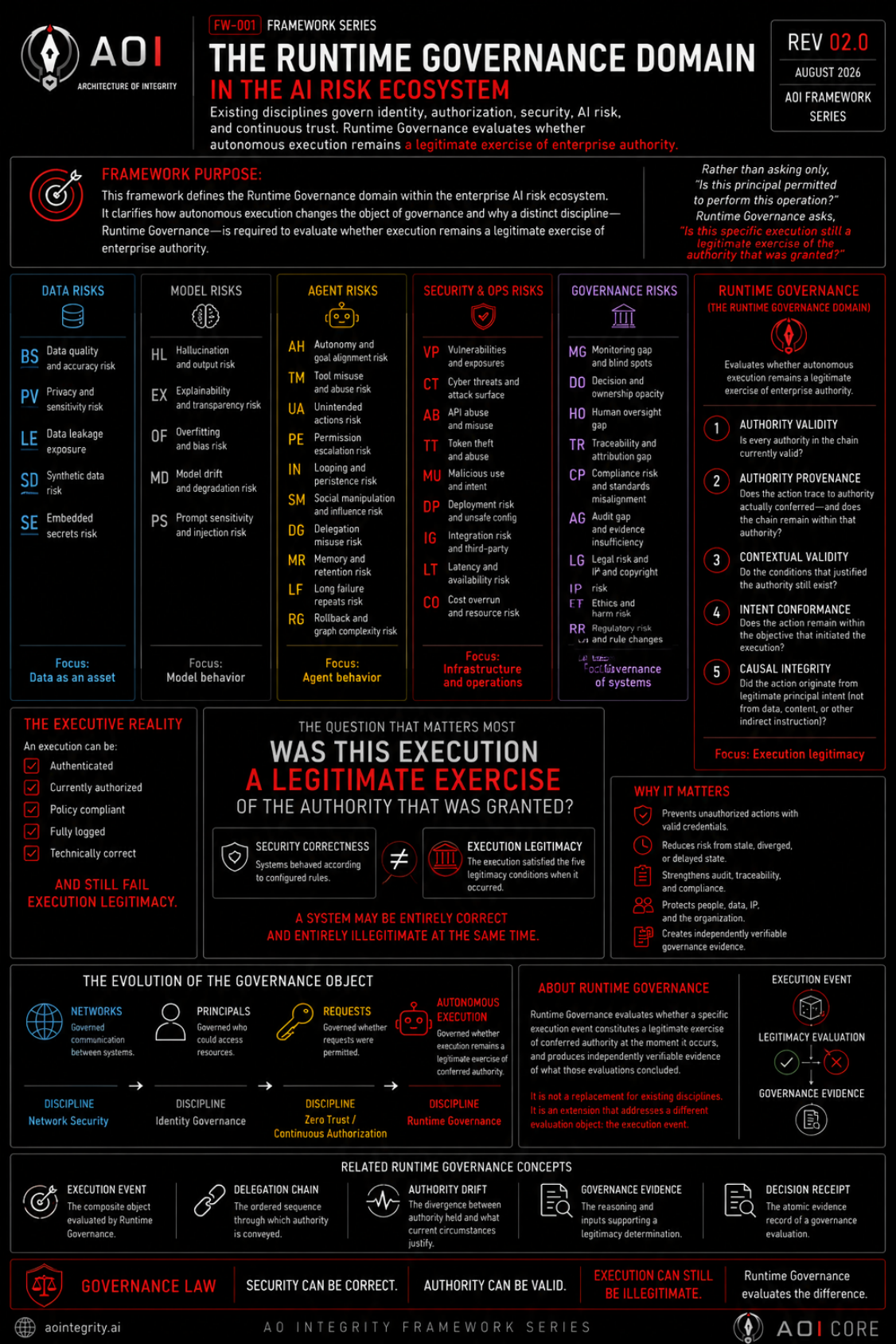
FW-001
Defines autonomous execution as the governance object evaluated by Runtime Governance.
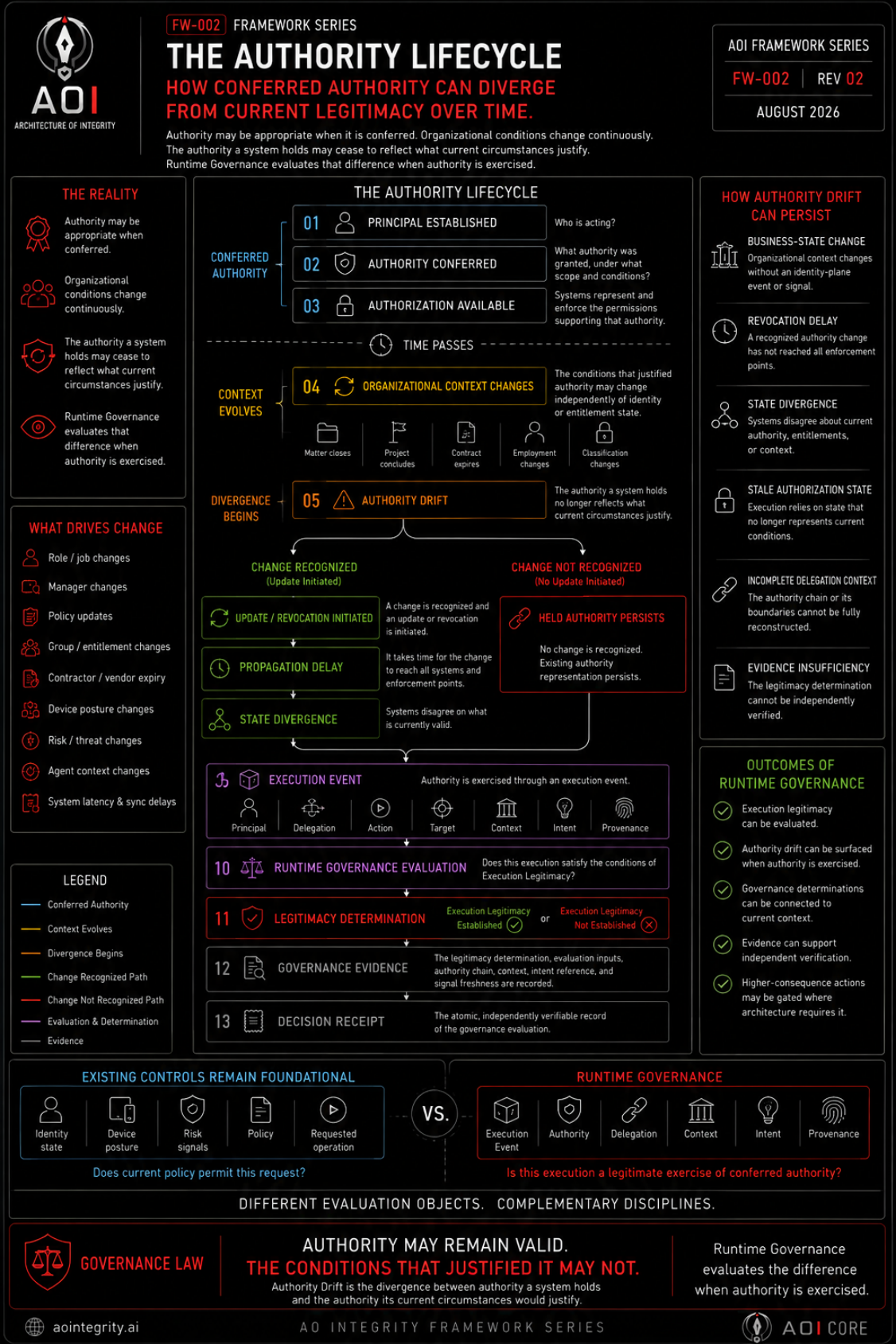
FW-002
Shows how conferred authority can diverge from what current organizational circumstances justify over time.
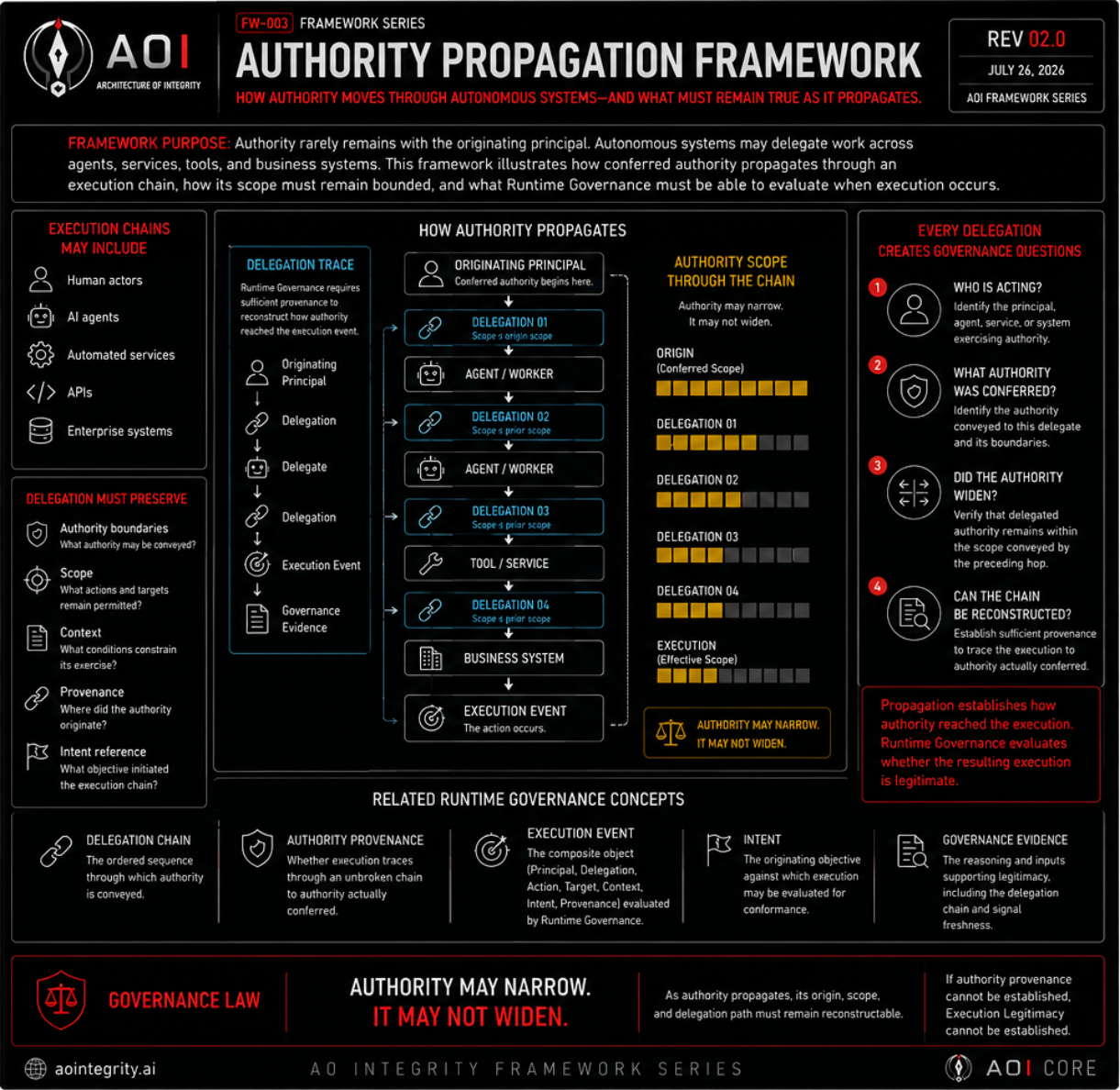
FW-003
Shows how conferred authority moves through delegation chains across autonomous actors, services, tools, and systems.
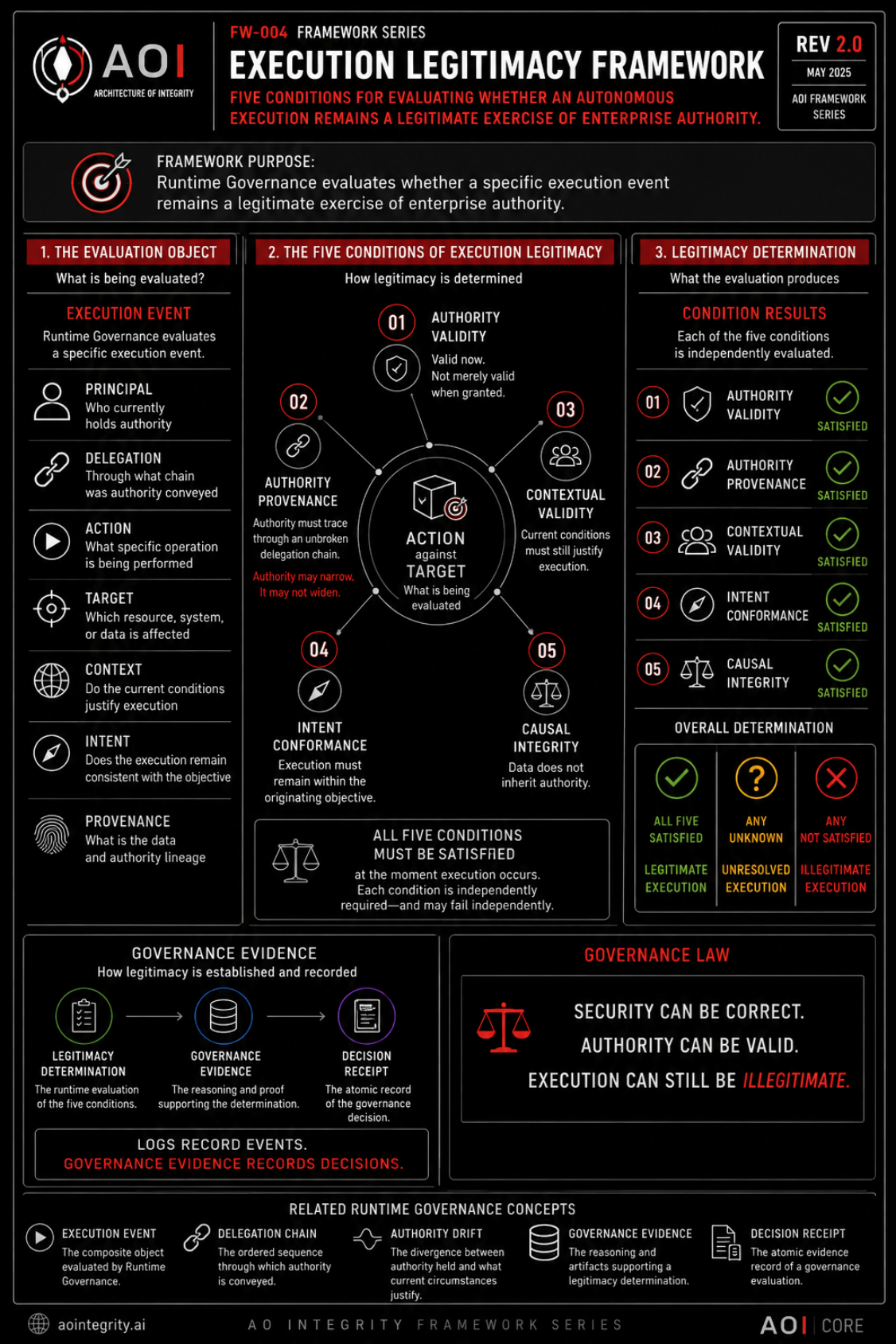
FW-004
Defines the five conditions used to evaluate whether a specific execution remains a legitimate exercise of conferred authority.
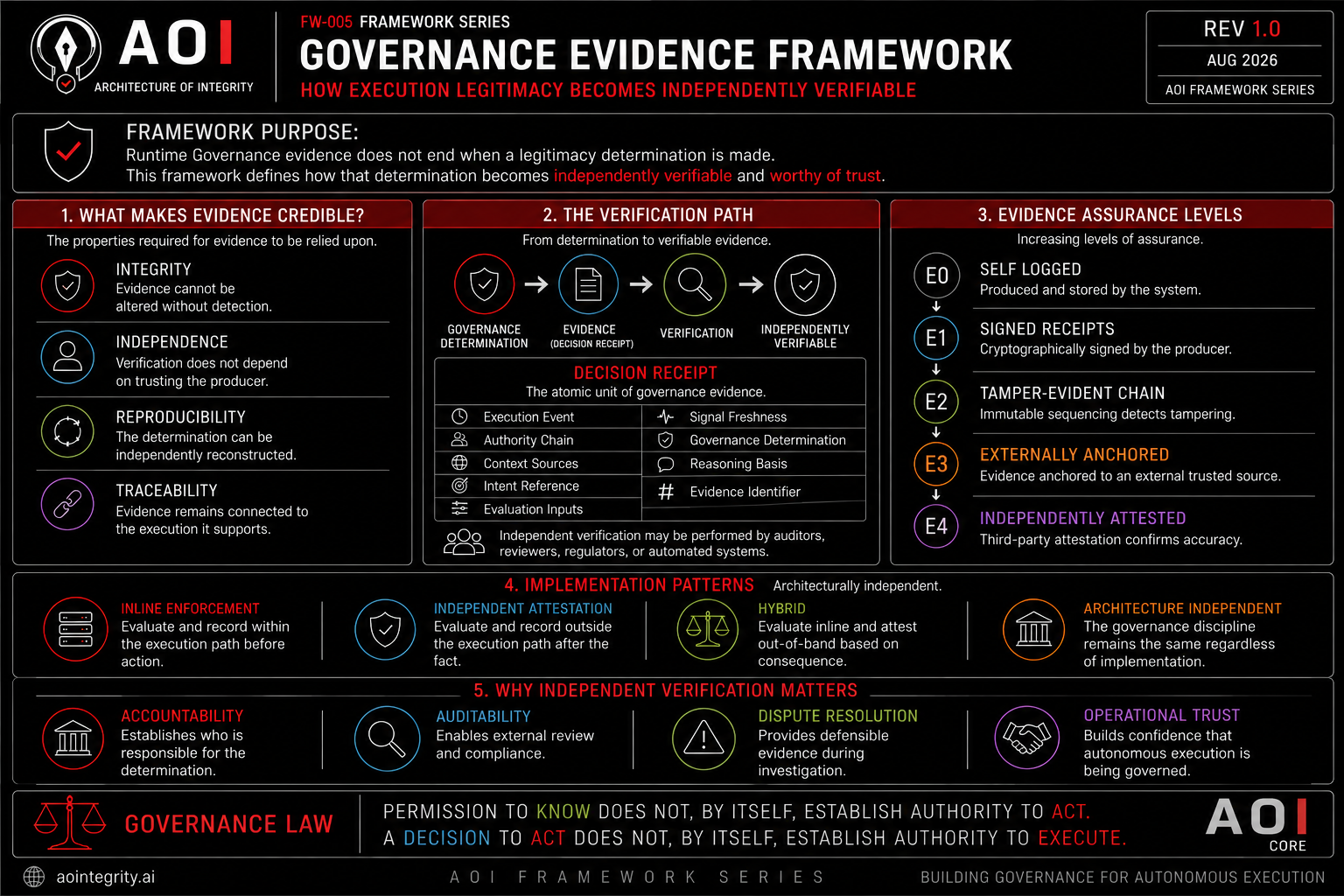
FW-005
Shows how legitimacy determinations become independently verifiable through governance evidence and decision receipts.
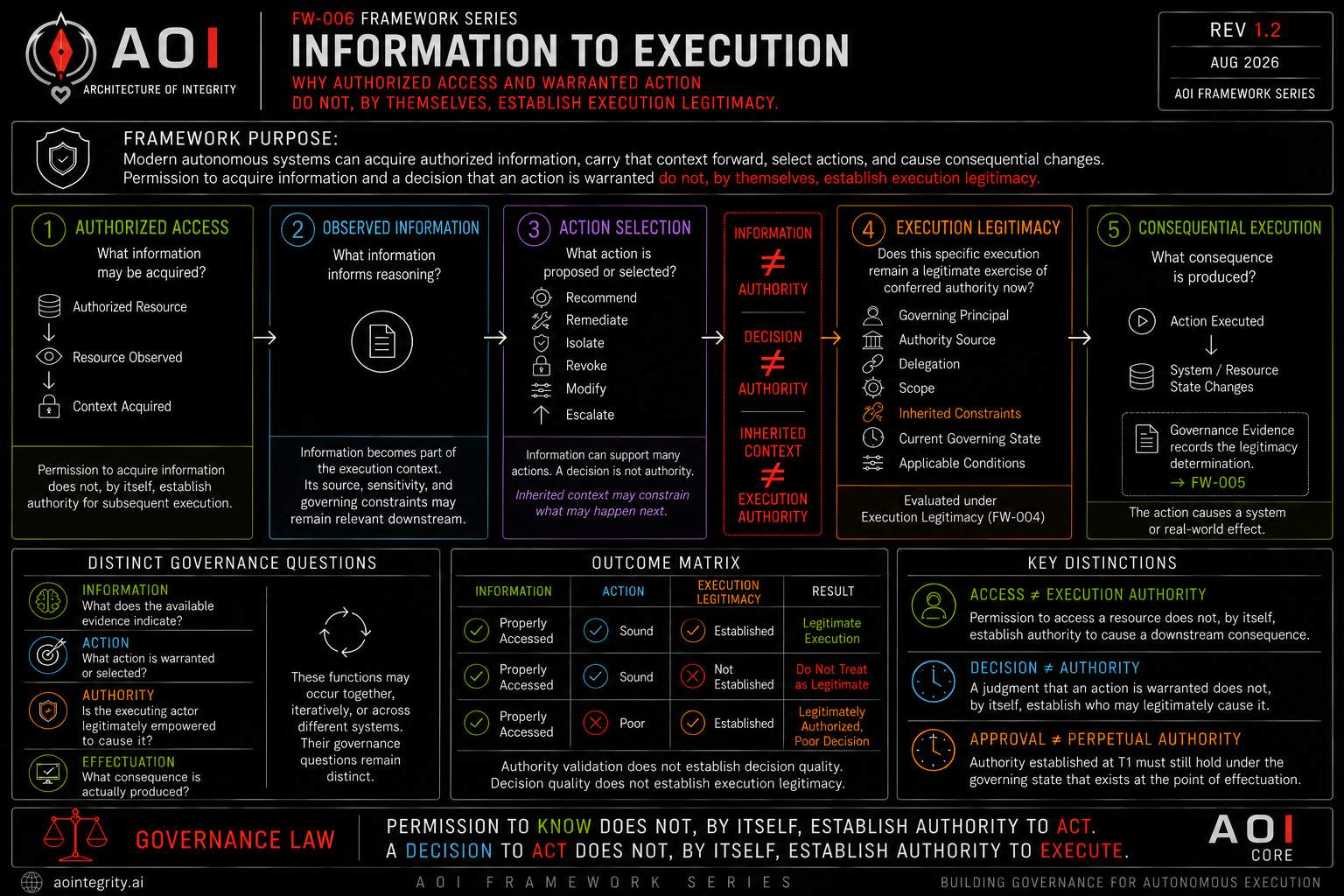
FW-006
Separates authorized access, observed information, action selection, execution legitimacy, and consequential execution.
The legitimate basis for a person, system, agent, or workflow to act.
A mismatch between changed authority and execution that remains active.
The point where authority records and operational execution no longer agree.
The duration that invalid authority remains operational.
Whether an action was backed by legitimate authority when it occurred.
Validation against present authority, context, and operational state.
Ongoing checks that authority remains legitimate during execution.
Risk created when active execution outlives legitimate authority.
Authority State
Observe changed authority
Execution State
Validate active execution
Authority Drift
Surface mismatches
Staleness Window
Measure duration
Governance Evidence
Produce reviewable evidence